2021
Hyundai i20
1.0 T-GDi 100 CV
Overview
The third-generation Hyundai i20 arrived in 2021 with a very clear proposition: to prove that a B-segment supermini could offer technology from the class above, bold styling and a modern powertrain without pushing the price too high. In its 100 hp 1.0 T-GDi manual version, the i20 incorporates a 48-volt mild-hybrid system that earns it Spain's ECO environmental label and reduces fuel consumption in everyday driving. Against such established rivals as the Volkswagen Polo, SEAT Ibiza and Renault Clio, the small Korean car plays the cards of comprehensive technology, a five-year unlimited-mileage warranty and a far more adventurous image than its predecessor.
Introduction and market positioning
Hyundai has made the B-segment one of its commercial pillars in Europe, and the i20 is the model that competes at the heart of the supermini market. The brand positions it as a rational choice with an emotional edge: it does not aim to be the cheapest car in its class, but the one that offers the most content for every euro spent. The 100 hp 1.0 T-GDi is precisely the most balanced version in the range, sitting above the naturally aspirated entry-level engine and below the more powerful variant. It is aimed at younger drivers and families seeking a second car that can also handle occasional motorway journeys.
Exterior design
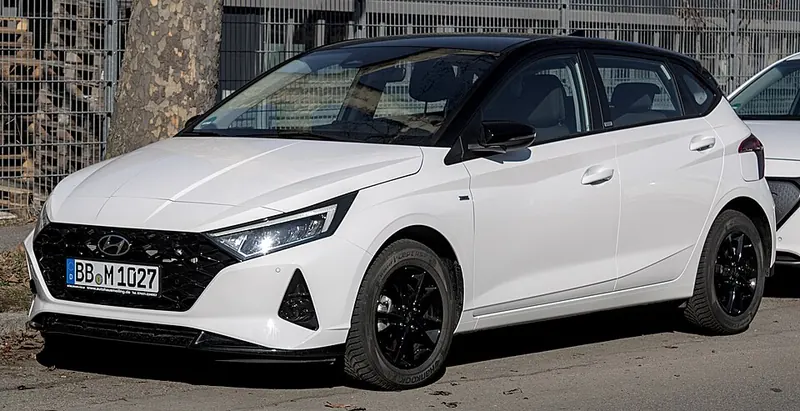
The third-generation i20 broke completely with the conservative styling of the previous model. Hyundai's Sensuous Sportiness design language translates into taut bodywork, pronounced creases along the sides, a wide and aggressive grille and sharp light units extending towards the wings. At the rear, the lights are connected by a strip running across the tailgate, while a black C-pillar creates a contemporary floating-roof effect. With five doors and compact proportions, the i20 is easy to park in town while conveying an unusual sense of solidity and maturity for its class. Alloy wheels, available in several sizes depending on the trim, and the option of two-tone bodywork reinforce its youthful character.
Interior and practicality
Inside, the generational leap is equally evident. The dashboard is arranged around two displays that can each measure up to 10.25 inches—one for the digital instruments and the other for the infotainment system—something few rivals in this segment offered in 2021. Most surfaces use hard plastics, as is standard in the class, but assembly quality is good and the surface design disguises the simplicity of the finishes effectively. Practicality is one of its strengths: it is approved for five occupants, offers enough rear space for two adults to travel comfortably on long journeys and provides a generously sized boot for the category, complete with a practical false floor. Storage compartments are plentiful, and the driving position offers a wide range of adjustment, allowing drivers of different heights to settle in comfortably.
Engine and performance
At the heart of this version is a turbocharged, direct-injection 1.0-litre T-GDi three-cylinder petrol engine producing 100 hp, paired with a six-speed manual gearbox. The 48-volt mild-hybrid system adds a small starter-generator that assists during acceleration, allows the engine to switch off while coasting and makes the stop-start system operate more smoothly. The figures describe an agile real-world package: its top speed of 188 km/h is more than sufficient for any European motorway, while official fuel consumption stands at a restrained 5.0 l/100 km. In practice, sensible mixed driving can produce figures close to the official rating, something that is not always true of small turbocharged engines. The three-cylinder unit feels lively, with a slight characteristic vibration at idle that disappears once moving, and pulls strongly from low revs thanks to the turbo and electrical assistance.
Driving dynamics
The i20 surprises with greater composure than one might expect from a supermini. Its steering is quick and sufficiently informative, the suspension absorbs urban road imperfections effectively without becoming too soft, and the body remains stable through a sequence of bends. The six-speed manual gearbox has a precise action and the light clutch is ideal for dense traffic. Motorway refinement is respectable for the class, although wind noise becomes noticeable at higher speeds, as it does in most rivals. Overall, it is easy, predictable and even entertaining when driven enthusiastically, without sacrificing the comfort required for everyday use. The brakes are appropriately sized for the car's low weight, offering a progressive feel and coping well with demanding use on mountain roads, while the tight turning circle makes urban manoeuvres straightforward.
Technology and equipment
This is where the i20 distinguishes itself. Depending on the trim, it offers a digital instrument cluster, a central touchscreen with navigation, wireless Apple CarPlay and Android Auto compatibility, wireless smartphone charging, parking sensors, a reversing camera and an optional Bose sound system rarely found in this segment. Bluelink connected services allow owners to view vehicle information from their phone and send destinations to the navigation system. Automatic climate control, push-button start and full LED headlights complete an equipment list capable of rivalling cars from the class above.
Safety and driver assistance
Under the SmartSense name, Hyundai offers a comprehensive package of standard or optional driver-assistance systems. These include autonomous emergency braking with pedestrian and cyclist detection, active lane-keeping assistance, adaptive cruise control, blind-spot monitoring, rear cross-traffic alert, driver-attention warning and traffic-sign recognition. The body structure uses high-strength steels and achieved good results in independent crash tests, with particularly strong adult-occupant protection.
Efficiency and running costs
The ECO environmental label awarded to the 48-volt mild-hybrid system is a significant advantage in major Spanish cities, where it can reduce or eliminate regulated parking charges and provides access to low-emission zones. Average fuel consumption of 5.0 l/100 km, combined with a sensibly sized tank, offers a generous range between refuelling stops. Maintenance costs are reasonable, servicing is competitively priced and the five-year unlimited-mileage warranty reduces the uncertainty of long-term ownership while supporting resale value. As a 100 hp model, insurance premiums remain moderate, even for less experienced drivers.
Range and trim levels
The Spanish i20 range was structured around several trim levels, from the entry model—already well equipped with a touchscreen and essential safety systems—to higher versions featuring a fully digital instrument display, larger wheels, bespoke upholstery and exclusive styling details. The 100 hp 1.0 T-GDi manual was available across virtually the entire range, allowing buyers to adjust their budget without giving up the most recommendable powertrain. Particularly worthwhile options included the two-tone roof, advanced driver-assistance package and premium audio system, additions that only modestly increased the price while significantly improving the experience on board. On the used market, this is one of the most sought-after versions because of its balance of price, environmental label and performance.
Rivals and alternatives
The i20 faces several heavyweights in its class. The Volkswagen Polo offers perceived quality and refinement; the SEAT Ibiza combines engaging handling with competitive prices; the Renault Clio stands out for its polished interior and hybrid version; the Peugeot 208 focuses on design and its i-Cockpit layout; while the Toyota Yaris plays the full-hybrid card. Against all of them, the Hyundai responds with more technology for the same money, a superior warranty and a mild-hybrid powertrain that combines a favourable environmental label with a conventional driving experience, without the idiosyncrasies of hybrid automatic transmissions.
Conclusion
The 100 hp Hyundai i20 1.0 T-GDi is one of the most complete B-segment options of its era. It is neither the most luxurious nor the cheapest, but it is one of the best balanced: economical, enjoyable to drive, generously equipped with technology and supported by a comprehensive warranty. For anyone seeking a rational supermini without sacrificing modern styling or the latest driver-assistance systems, it is a very solid purchase.
Pros:
- Exceptionally comprehensive technology for the segment, with dual displays and wireless connectivity.
- Sensible fuel consumption of 5.0 l/100 km and an ECO environmental label thanks to the 48-volt mild-hybrid system.
- Five-year unlimited-mileage warranty.
- Agile, secure handling and a precise manual gearbox.
- Good passenger space and a large boot for the class.
Cons:
- Extensive use of hard plastics throughout the cabin.
- The three-cylinder engine transmits slight vibrations at idle.
- Noticeable wind noise at motorway speeds.
- Bold exterior styling may not appeal to more conservative tastes.
Specifications
- Year
- 2021
- Fuel
- Gasoline
- Transmission
- Manual
- Power
- 100 hp
- Top speed
- 188 km/h
- Fuel consumption
- 5 L/100 km
- Seats
- 5
- Doors
- 5
Photo by Alexander Migl · CC BY-SA 4.0 · Source